
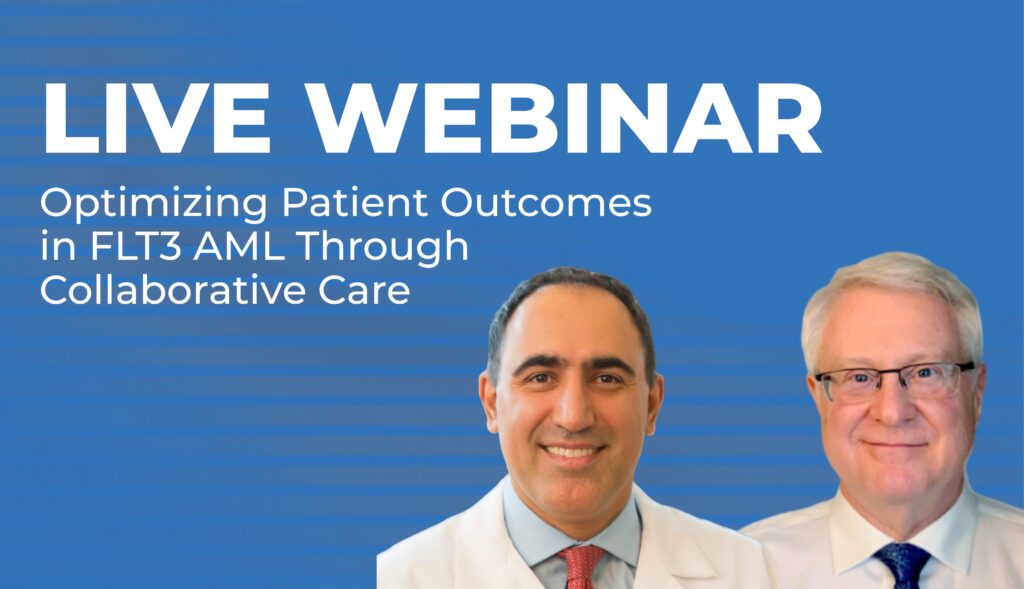
Optimizing Patient Outcomes in FLT3 AML Through Collaborative Care
7:00 – 8:00 PM EST
Learning Objectives
- Describe the FLT3-mutated AML patient journey, including key decision points and the roles of the multidisciplinary care team.
- Apply strategies for improving care coordination, especially during transitions between treatment phases and care settings.
- Discuss approaches to maintenance therapy and long-term follow-up, with a focus on overcoming barriers in rural communities and underserved populations.
Why Attend?
The treatment landscape for FLT3-mutated AML is rapidly evolving, creating new challenges in coordinating optimal patient care. This Expert Brief will review the evolution of treatment for newly diagnosed patients eligible for intensive induction therapy and provide practical insights for managing FLT3 AML through a multidisciplinary team approach.
Learn strategies for patient monitoring, adverse event management, care coordination across treatment centers, and optimizing follow-up—including considerations for maintenance therapy and patients living far from specialized centers.
Event Co-Chairs

Brian Leber
MDCM, FRCPC
Dr. Brian Leber is a clinical hematologist and Emeritus Professor of Medicine (Hematology) at McMaster University. He was the prior Head of the Leukaemia Disease Site Group at the Juravinski Cancer Centre of Hamilton Health Sciences, and was Director of the Collection facility within the Cellular Transplant Programme. He has a long-standing interest in the pathophysiology of leukemia and investigational new drug trials, and with Dr. David Andrews of the Department of Biochemistry has participated in research on the basic cellular, biochemical and biophysical mechanisms of apoptosis. He is the current Chair of the Canadian Leukemia Study Group/Groupe Canadien d’Etude sur la Leucemie.
Amir Fathi
MD
Dr. Amir T. Fathi is the Program Director of the Center for Leukemia at the Massachusetts General Hospital Cancer Center; he is also an Associate Professor in Medicine at Harvard Medical School. Dr. Fathi is a clinician-scientist with a deep interest in developing novel therapies for acute myeloid leukemia (AML).
Unfortunately, the outcomes for patients with AML continue to be poor despite incremental advances in treatment and supportive care over last 30 years. Although most patients respond to initial treatment, the majority eventually relapse and many succumb to their disease. Therefore, new and innovative approaches are desperately needed to significantly improve outcomes.
As faculty at the MGH Cancer Center and Harvard Medical School, he provides clinical care, supervises trainees, administers a busy clinic, and as the director of clinical research in leukemia, is the lead investigator on numerous clinical trials investigating novel treatments in acute leukemias. His other interests focus on developing translational projects to discover new targets for therapy. He has presented at national meetings of the American Society of Clinical Oncology (ASCO) and the American Society of Hematology (ASH), spoken at national academic and educational meetings, and has served on national committees that establish guidelines for the management of acute and chronic leukemias. Dr. Fathi endeavors to provide outstanding clinical care, teaching and mentoring, while also conducting translational projects, retrospective research, and clinical trials, with the overarching goal improving the health and outcomes of patients with bone marrow malignancies.
Dr. Fathi is a graduate of Yale University, where he graduated summa cum laude with a Baccalaureate of Science in molecular, cellular, and developmental biology. He went on to receive his medical degree with Honors at the Yale School of Medicine. He also has a Masters degree in Epidemiology from Harvard School of Public Health. He completed his residency training in internal medicine at Massachusetts General Hospital, and fellowships in both hematology and medical oncology at Johns Hopkins Hospital.
This session is part of a multi-channel educational series aimed at improving clinical confidence and patient care in the era of ALK inhibitor therapy
This program has been made possible through unrestricted support from Daiichi Sankyo.

